

Step 1
Go to the image gallery on your phone or google and choose an image (it can be of any type: a photo,a painting, an illustration, a cartoon, etc.) which is important to you.
Step 2
Now, write and describe your photo and explain why this image is important to you.
Step 3
Write the different type of images you can think of.
Step 4
Now you will watch, but only the image of the video,(with no audio) a short film about images. As you watch, consider what the film is about, how it makes you feel and what different types of images you see.
Watch the film starting at 00:05 and finishing at 02:05 with no sound.
https://player.vimeo.com/video/113420504
Step 5
Now that you have watched, what do you think the film is about? How does it make you feel?
What are the different types of images you can see? Write some notes.
Step 6
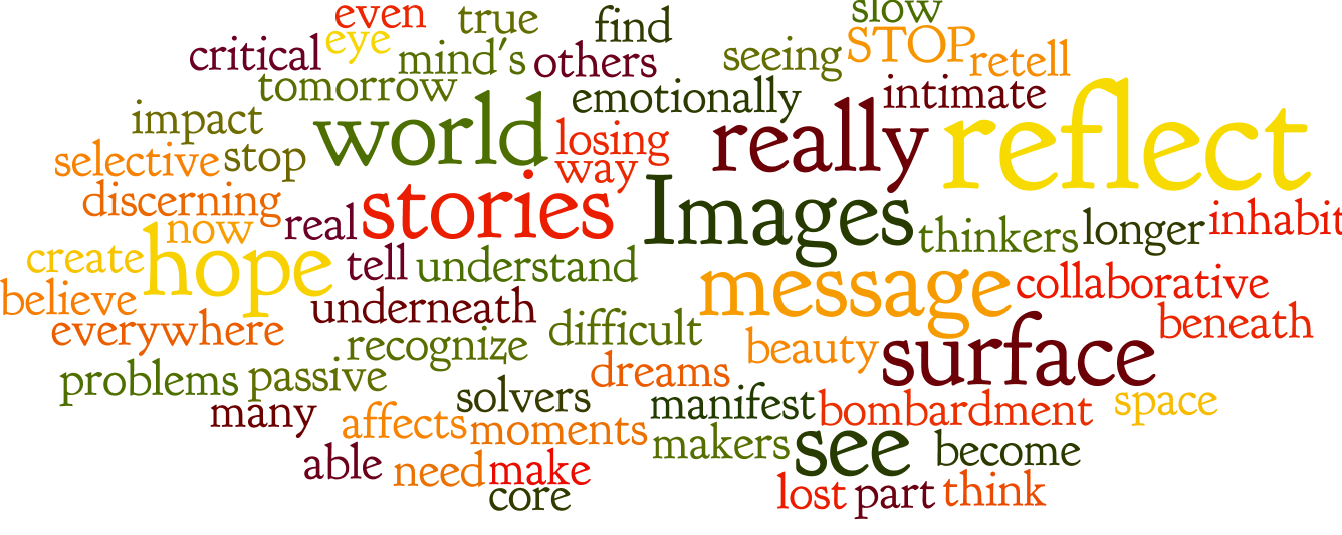
Have a look at this word cloud and look up the meaning of any vocabulary you don’t understand.
Step 7
Now, watch the film with sound and answer the question. What do you think is the film’s message?
Step 8
Below is the narrative for the film.Read it and look up the meaning of difficult vocabulary.
Images, they create our world. They inhabit our space.They reflect what’s in our mind’s eye. and are at the core of what we believe in What we hope for The beauty we see in others, in ourselves The hope we find, even in difficult moments Images are an intimate part of our world, and they are everywhere. But how do we reflect on them now with so many at once? Are they losing their impact? Do we really understand the message? Or is it lost in the bombardment? What do we need to do to make it STOP? We can no longer be passive. We have to be more discerning, more selective, more collaborative. We have to recognize the stories, on the surface and underneath, and retell them in our own way or tell our own stories. We have to slow down, stop, reflect, think about what we’re seeing, why it’s there, how it affects us, what it does to us emotionally and why. When we are able to do this, we see beneath the surface to what is really there. And only then do become the real message makers, the critical thinkers, the true problems solvers who manifest the dreams of tomorrow.
Step 9
Answer the following questions.
1.Do you feel images bombard us?
2.What role do images play in your life?
3.What type of images do you see on a normal day?
4.Do you use your mobile phone to take a photo? If so, what type of photos do you take?
5.Do you feel we look at images passively?
6.What can we do to be more critical when dealing with images?
7.How can we tell stories with images?
8.Have you ever made a video? If so, what story did it tell?